
ScaleUp Executive Leadership Essentials
Based on extensive research from The Center for Creative
Leadership, Korn Ferry, and the American Management Association—
as well as my experience coaching and consulting with senior
leaders—I’ve distilled the core competencies required for modern
executive effectiveness. I call this framework the Executive
Leadership Essentials (ELE).
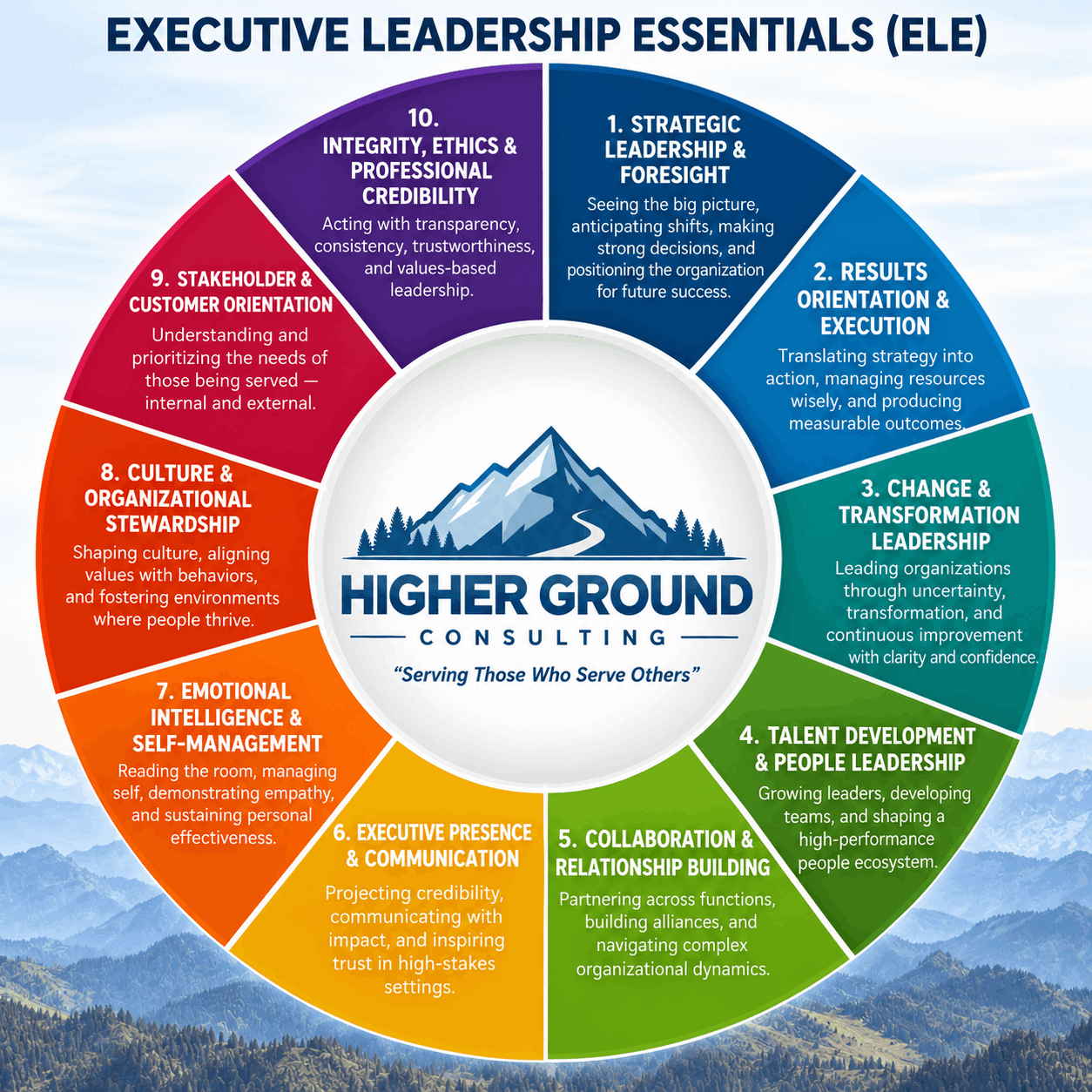
 Higher Ground has created an ELE Survey to identify the strengths executives should leverage and the gaps that may be limiting the person, the position, or the organization.
The assessment highlights the areas with the greatest opportunity for development and provides a roadmap for targeted growth.
Can your organization benefit from focusing on a specific competency, customizing the order of focus areas, or scheduling a private session for your senior leadership team, we’d welcome a conversation to explore what would serve you best.
Top 10 Executive Competencies Defined
- Strategic Leadership & Foresight
(Combines: Strategic Thinking, Decision Quality, Innovation) Seeing the big picture, anticipating shifts, making strong decisions, and positioning the organization for future success.
- Results Orientation & Execution
(Combines: Driving Results, Financial/Business Acumen)
Translating strategy into action, managing resources wisely, and producing measurable outcomes.
- Change & Transformation Leadership
(Combines: Change Leadership, Growth Mindset)
Leading organizations through uncertainty, transformation, and continuous improvement with clarity and confidence.
- Talent Development & People Leadership
(Combines: Leadership Development, Coaching, Succession, Team Optimization)
Growing leaders, developing teams, and shaping a high-performance people ecosystem.
- Collaboration & Relationship Building
(Combines: Collaboration, Influence, Political Savvy)
Partnering across functions, building alliances, and navigating complex organizational dynamics.
- Executive Presence & Communication
(Combines: Presence, Communication Mastery, Influence)
Projecting credibility, communicating with impact, and inspiring trust in high stakes settings.
- Emotional Intelligence & Self-Management
(Combines: Emotional Intelligence, Authentic Leadership)
Reading the room, managing self, demonstrating empathy, and sustaining personal effectiveness.
- Culture & Organizational Stewardship
(Combines: Culture Leadership, DEI, Organizational Awareness) Shaping culture, aligning values with behaviors, and fostering environments where people thrive.
- Stakeholder & Customer Orientation
(Combines: Customer Focus, Donor/Partner Alignment)
Understanding and prioritizing the needs of those being served — internal and external.
- Integrity, Ethics & Professional Credibility
(Standalone — non-negotiable foundation across all frameworks) Acting with transparency, consistency, trustworthiness, and values-based leadership.


